
· SG HIRSCHI
What does a race controller actually do?
When the pigeons rise to heaven for the first time in spring, a special time begins for breeders, but for everything to run smoothly, you need someone in the background to coordinate, plan and decide: the flight manager.
Season start: Young pigeons, training and first flights
After the rearing of the pigeons in February and March, many breeders start preparing for the season with the pigeon pigeons during April. Even before and during the rearing, the piges have a daily free flight at the house. At the end and after the rearing there is a phase where private training flights are first on the program, in which the condition of the carrier pigeons is trained step by step. Shortly afterwards, the jointly carried out pre-flights, in which pigeons get used to transport, foreign environments and flight behavior in the swarm. The pigeons learn to separate from the swarmed in time so that they can fly safely their home stroke.
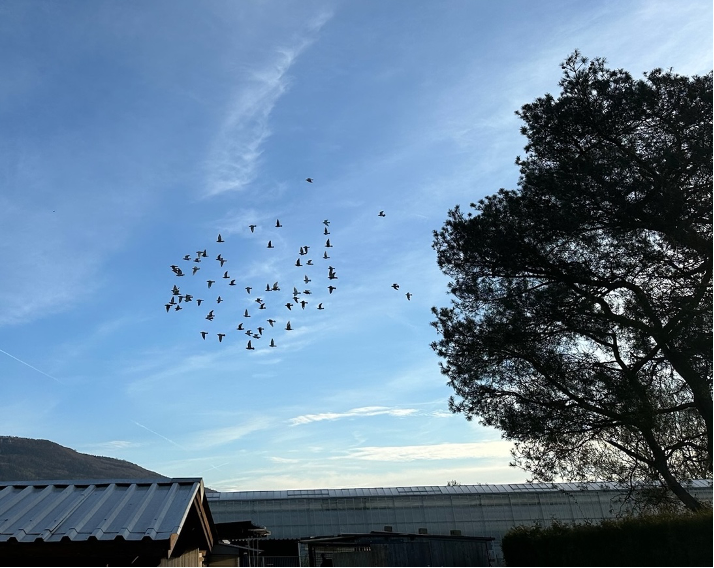
This phase is essential to gradually prepare the animals for the upcoming flights – and at the same time, the actual work begins for the flight managers.
The flight season: 12 weekends full of excitement
The actual flight season takes place over twelve weekends in May, June and July. Each of these weekends, a flight is carried out over distances between 150 and 650 kilometres, and not only the training of the animals is crucial, but also the organization in the background, because without planning, weather monitoring, communication and coordination, not a single one of these flights would be conceivable - and that's where the flight manager comes into play.
Who decides where to fly from?
Right at the start of the season, each club agrees on a mandatory flight programme which specifies from which locations to launch over the course of the weeks. This planning is based on geographical conditions, experience and the aspiration to introduce the pigeons step by step to greater challenges.
But even the best program remains only theory, if it is not compared with the weather and reality – one of the central tasks of the flight manager.
Weather Observation: Daily View of the Sky
A good flight commander starts to analyze the weather situation during the week, taking into account various parameters: wind directions and strengths, fog development, rainfall probability, cloudiness, temperature fluctuations and solar radiation. 2m from the ground, 50m and 100m from the ground) can be checked.
Overall, the art consists in finding a day of flight on which conditions are as fair as possible for all participants – and at the same time the welfare of the animals is always the focus. Often flights also have to be cancelled altogether, because the weather over several days simply does not allow safe intake for the pigeons.
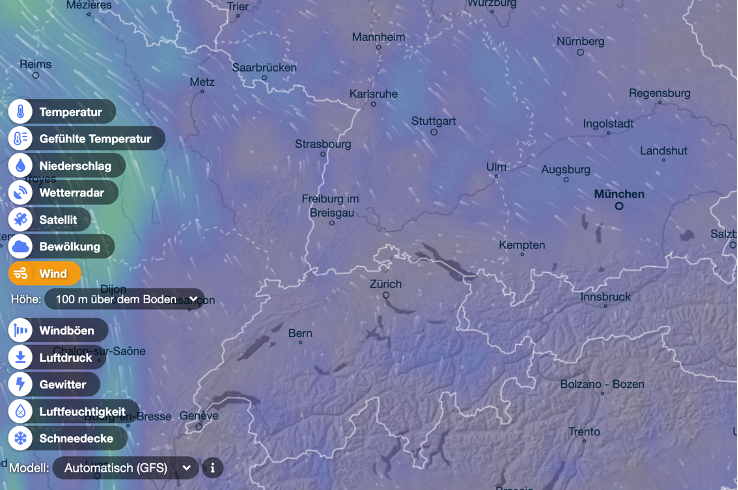
As soon as a potential day of disembarkation is looming, the flight manager will inform the members of the club and announce when (usually two days before) the number of pigeons to be deployed must be reported.
Organization around the deployment
Based on the feedback from breeders, it is planned how many boxes are needed for transport. On the day of deployment, the breeders meet at the known deployment sites, register their pigeons and load them into the ready transport boxes.
These boxes are then loaded into the so-called “Kabi” – the cabin cart. The Kabi is a specially equipped vehicle that offers optimal conditions for the transport of animals. Good ventilation, shaded and low vibration ensures a stress-free journey of the pigeons. The pigeons can be supplied with water in the Kabi without any problems.
Here, too, the flight manager is responsible: he organizes the drivers, plans the route and ensures that everything runs on time; each driver must be trained by an experienced driver before his first assignment.
Technology and timing: The last decision lies with the flight manager
A modern GPS system enables the flight manager to control the exact location of the Kabis at any time. In a specially developed web application, vehicles from other flying communities, such as the German Pigeon Federation, can also be viewed.
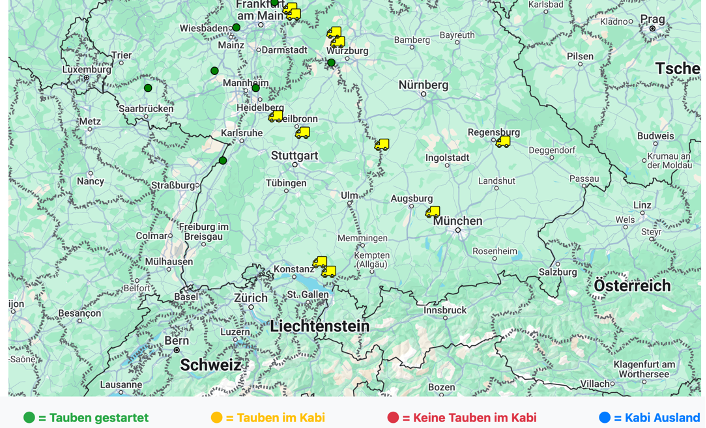
On the morning of the flight day, it means for the flight manager to get up early. Now it is important to find the optimal time of disembarkation - a decision that takes many factors into account. In addition to the current weather, also plays a role when neighboring clubs leave their pigeons. After all, the swarms should not cross in the air. The short-term scheduled disembarking time is immediately entered in a portal so that other airline communities can take this into account in their planning.
Only when everything fits, the flight manager gives the driver the definitive “GO”. The flaps open, the abandonment takes place – and the journey of the carrier pigeons begins.
Communication: Everyone wants to know
As soon as the pigeons are in the air, the flight manager informs the club - usually via a group chat on WhatsApp - about the abandonment. Now the big wait begins. The tension increases, everyone calculates, hopes and looks at the sky. When do the first ones come back?
The Big Moment: Homecoming of the Pigeons
It is a feeling that can hardly be put into words: when the first pigeons return, after hundreds of kilometres, single-minded and energetic, the heartbeat of breeders and spectators is guaranteed. The pride of the animals and the joy of their return make all the efforts of preparation forget.
A silent hero in the background
And this is where it's time to stop and say thank you, because without the help of flight managers, not a single one of those moments would happen. They make sure that everything goes smoothly week after week with a high level of responsibility, expertise and attention to detail.
Thanks to them, we can live and pass on this timeless hobby. It is their silent commitment that forms the basis for our pigeons to fly safely – and find home safely.
Archived original article. Media credits in the article are preserved.
← Journal